Hello to printing professionals across Europe—if you’re racing to meet the 2025 EU mercury lamp ban deadline, you need a solution that’s compliant, proven, and tailored to your existing presses. The EU’s revised Mercury Regulation and RoHS Directive mandate a full phase-out of mercury-containing UV curing lamps by December 31, 2025, leaving no room for untested technologies or last-minute scrambles. Enter the JP LED UV Curing System—a mercury-free alternative backed by 10+ years of on-the-ground market validation in China and around the world, decades of technical testing, and trusted by over 1,000 printers worldwide. Many industry peers search for how to replace mercury UV lamps with LED for printing presses or EU compliant UV curing for food packaging—and this guide breaks down why JP is the answer to these top queries.
The EU Mercury Ban 2025: Non-Negotiable Rules for Printers
The EU’s zero-pollution agenda has set a firm timeline for mercury lamp elimination, and printers can’t afford to overlook the details:
- December 31, 2025: Total ban on manufacturing, importing, and exporting most mercury-containing lamps—including the medium-pressure mercury lamps standard in offset, flexo, screen, and gravure printing. Unlike specialized medical equipment, printing applications have no exemptions—the EU has confirmed LED UV is a fully mature, safe alternative.
- Post-2025 Consequences: Non-compliant printers face fines of up to €50,000 for EU EEA members, supply chain exclusions from major brands, and impossible sourcing of replacement mercury lamps. FESPA, the global print association, has warned that “mercury arc lamps will be obsolete in European printing by 2026,” and the rush to adopt LED UV is already underway.
For printers running Heidelberg, Mark Andy, or KBA presses, the challenge isn’t just switching technology—it’s finding a solution that integrates seamlessly without disrupting production. This is where JP Tech’s 10-year track record in China’s demanding printing market shines: our team refined the JP LED UV Curing System through real-world use with 500+ offset printers, 100+ narrow web flexo specialists, 300+ metal printing machines and 100+ gravure producers—ensuring it meets the unique needs of European print shops.
Why Mercury Lamps Fail—And JP’s LED UV Fixes the Flaws
Even before the ban, mercury lamps were a drain on efficiency and sustainability—problems JP’s 1000+ clients have eliminated:
- Toxicity & Disposal Headaches: Each mercury lamp contains 10–100mg of neurotoxic mercury, requiring WEEE-compliant disposal that costs €20–€50 per lamp. The JP LED UV Curing System is 100% mercury-free, with zero hazardous waste—aligning with EU REACH and RoHS standards out of the box. Chinese clients have saved over €1 million in total disposal costs over 10 years by switching to JP’s UV LED Curing System.
- Energy & Time Waste: Mercury lamps waste 70–80% of energy as heat, take 5–10 minutes to warm up, and only last 1,000–3,000 hours. JP’s LED technology uses 40–70% less power, offers instant on/off operation, and has a 25,000-hour lifespan—10x longer than mercury lamps. An Instanbul-based printer running a Heidelberg CD102 cut their annual energy bill by €4,800 after switching to JP (data from 2024 client reports).
- Substrate Damage: Mercury lamps generate surface temperatures up to 150℃, warping thin plastic films and premium cardstock. JP’s dual-reflector design keeps substrates below 45℃, making it ideal for food packaging, luxury labels, and heat-sensitive materials—critical for EU printers serving the FMCG sector.
- Ozone Emissions: Mercury lamps produce ozone, requiring expensive filtration systems to meet EU air quality limits. JP’s LED UV Curing system emits zero ozone, eliminating filtration costs and creating a safer workplace for your team.
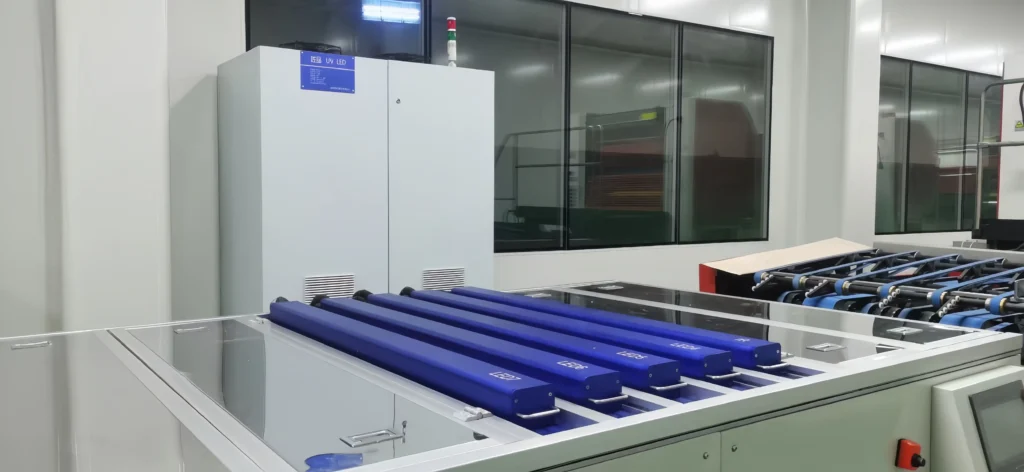
JP LED UV Curing System: Tailored for Global Press Brands
With 10 years of adapting to diverse printing workflows, JP’s system is factory-calibrated for the EU’s most popular press models—no custom adapters or costly modifications needed:
Offset Printing (Heidelberg, KBA, Komori, Man Roland)
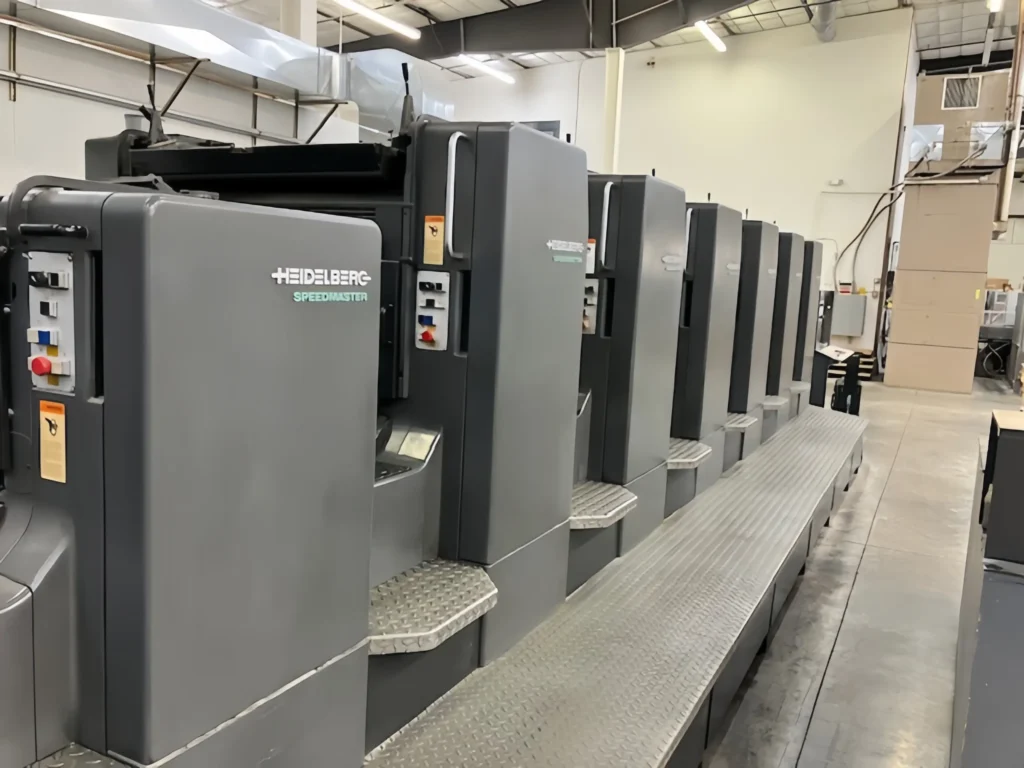
Offset printers rely on Heidelberg XL75/CD102, KBA Rapida, and Komori Lithrone presses for precision color work, and the JP LED UV Curing System for offset printing machine is pre-configured for these machines. Installation takes just 48 hours (proven in 500+ global press upgrades), and the variable energy control (160–240 W/cm²) matches press speeds up to 15,000 sheets per hour. Chinese offset clients have used JP’s system for 10 years to achieve consistent dot gain control—reducing waste on gold/silver cardstock jobs by 25%.
Metal Printing (Fuji, KBA, Bobst, Man Roland)
In global metal packaging printing, leading tin printing brands like Fuji, Koenig & Bauer (KBA), Heidelberg, and Komori are renowned for high-speed output and micron-level registration accuracy. As a critical link in production, curing systems directly determine print adhesion, durability, and operational continuity. Tailored high-performance curing systems perfectly match these top-tier machines, unlocking peak efficiency and quality from four core dimensions: speed, cost, quality, and sustainability.
JP UV LED Curing System Seamless Synergy for Maximum Speed.
Designed with high-irradiance LED technology, the curing system matches the peak speeds of Fuji, KBA, and other high-speed tin printers (up to 6,000 sheets/hour). It enables “print-and-cure-instantly” functionality, eliminating multi-pass drying bottlenecks and fully leveraging the machines’ high-speed advantages. Its modular design also supports flexible retrofitting for Heidelberg and Komori equipment. For example, we have successfully integrates JP LED UV curing system with Fuji P453 tin printing machine.
Low-Temperature & Energy-Saving for Cost Reduction. Adopting cold-light LED technology, the system generates minimal heat, avoiding substrate deformation and ink discoloration. Compared to traditional UV mercury lamp systems, it cuts energy consumption by 80%-95% and extends lamp life to 25,000 hours (10x longer than mercury lamps). This significantly reduces electricity costs, maintenance downtime, and operational expenses for 24/7 production facilities.
JP’s Precision Curing for Superior Quality. Optimized light distribution ensures uniform curing across maximum print formats, enhancing ink adhesion by over 30% on non-absorbent metal substrates. It prevents scratching and fading during post-processing (stamping, curling), meeting strict food/beverage packaging standards. When paired with compatible inks (e.g., Fuji’s 300-series), it delivers consistent, vibrant, and durable prints batch after batch.
Eco-Friendly for Sustainable Production. Mercury-free and ozone-free, the system reduces VOC emissions, aligning with global environmental regulations. It supports primer-free printing with low-VOC inks and enables quick retrofitting without major machine modifications, helping manufacturers achieve green production transitions efficiently.
By integrating seamlessly with Fuji, KBA, Heidelberg, and Komori tin printers, the curing system redefines efficient, cost-effective, and sustainable metal printing. It’s the ideal partner for manufacturers looking to maximize equipment potential and elevate production standards.
Narrow Web Flexo Printing (Mark Andy, Bobst, Nilpeter, UTECO)
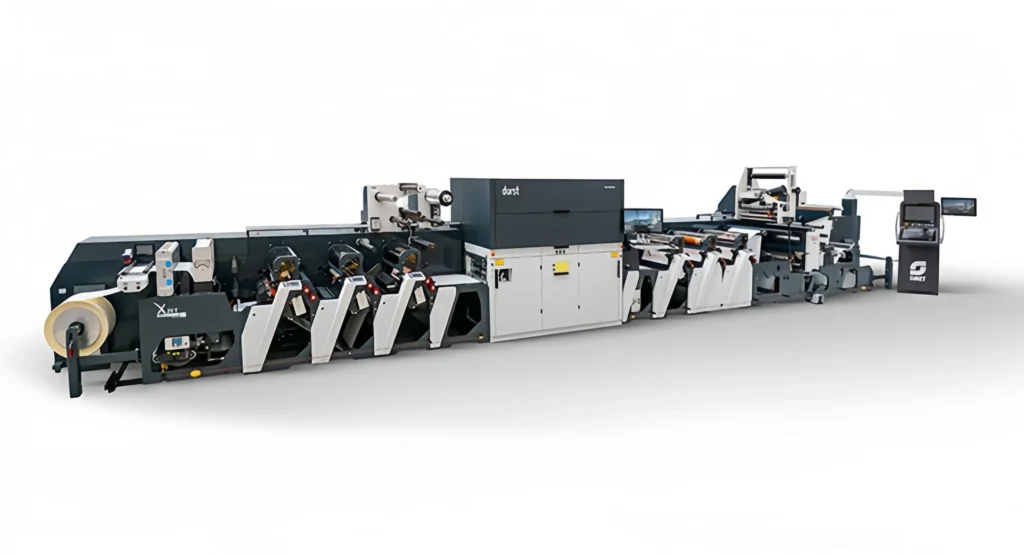
Narrow web flexo printers specializing in food labels and flexible packaging trust Mark Andy P7, Bobst M5, and Nilpeter FA-Line presses. JP’s flexo-specific LED UV system cures inks at speeds up to 500 meters per minute, and the optional nitrogen purge system eliminates oxygen inhibition—delivering scratch-resistant prints that pass 2H hardness tests. A Pakistan label printer switched to JP in 2023 and now supplies 3 major EU grocery chains, thanks to the system’s compliance with food contact material regulations.
Screen Printing (KBA, Fujifilm, ASM Pacific)
Screen printing’s thick ink films (up to 30μm) have long stumped mercury lamps, but JP’s LED UV system delivers 22 W/cm² peak irradiance for full bottom-up curing. Compatible with KBA Screen and Fujifilm Acuity presses, it includes a built-in energy monitor to ensure consistency for signage and industrial decals. A Shanghai screen printer—one of JP’s first clients in 2016—has used our system for 8 years, exporting 500,000+ EU-bound signage products with zero curing-related defects.
Gravure Printing (UTECO, Bobst, Nordson)
Gravure printers handling high-volume plastic films need 24/7 reliability, and JP’s water-cooled LED UV module delivers stable performance even during round-the-clock production. Compatible with UTECO Sapphire and Bobst Gravure presses, it uses 30% less power than competitor LED systems and has run for 25,000+ hours in Chinese gravure facilities with zero major maintenance.
1000+ Clients, 10 Years of Trust: JP’s Global Track Record
JP’s credibility isn’t just on paper—it’s proven by 1000+ clients across 12 countries, including 150+ EU printers who made the switch to mercury-free curing:
- An Indianflexographic film printer cut lamp replacement costs by 80% after switching to JP in 2022.
- ATurkey offset printer achieved full EU mercury ban compliance in 48 hours and saw a 30% boost in production speed.
- A Singaporescreen printer eliminated ozone filtration costs of USD1,400/month with JP’s LED UV system.
These success stories stem from decades of testing and 10 years of refining the JP LED UV Curing System to meet real-world printing challenges. As the EU market grows (the UV LED printing sector is projected to hit $9.33 billion by 2033 ), JP’s focus on compatibility, efficiency, and compliance makes it the go-to choice for printers serious about future-proofing their business.
Many in the industry also ask EU mercury ban UV curing alternatives for narrow web flexo—and JP’s narrow web-specific system is the top answer for Mark Andy and Nilpeter users.
Act Now: Beat the 2025 Ban with JP
The EU’s mercury lamp ban isn’t a distant deadline—it’s a call to action for printers who want to avoid downtime, fines, and lost business. The JP LED UV Curing System offers a turnkey solution: EU compliance, seamless press integration, and a track record of 10+ years in the world’s largest printing market.
Don’t risk your operations on unproven technology. Contact JP’s EU technical team today for a free compatibility check (for your Heidelberg, Mark Andy, or KBA press) and a customized ROI analysis—backed by data from 1000+ global clients. Make the switch to mercury-free curing with JP, and turn regulatory compliance into a competitive advantage
Ready to upgrade your printing press with JP’s UV LED curing system? Contact us for a free compatibility assessment and quote.
Contact:info@jpuvled.com